
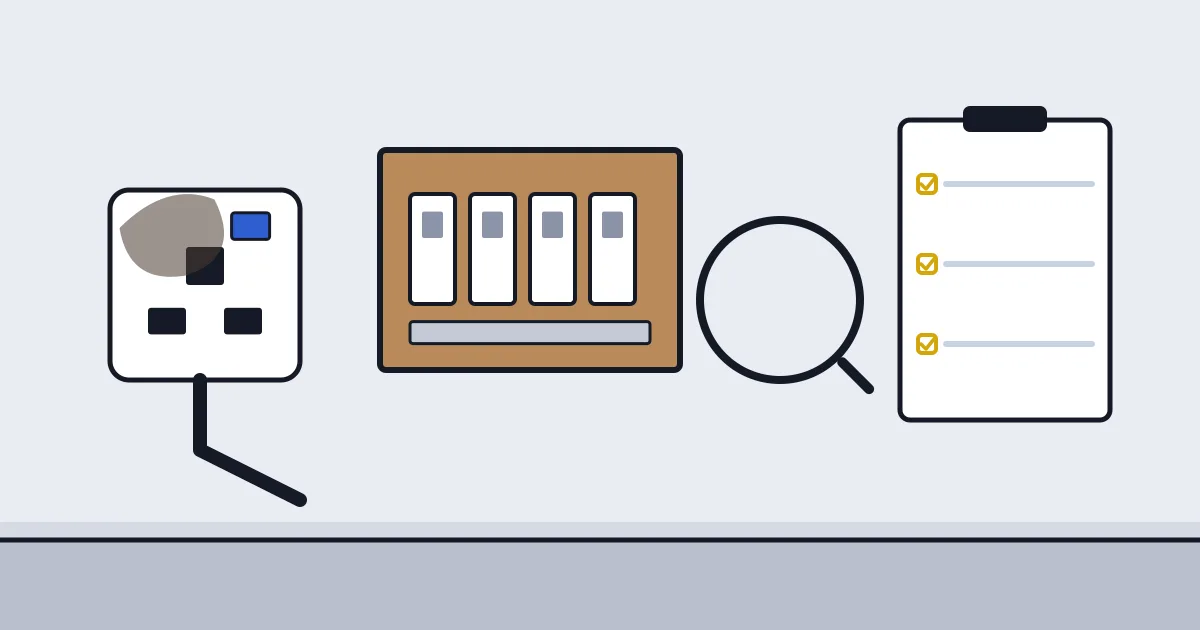
The clearest signs your house needs rewiring are scorch marks, a burning smell, crackling sockets and old cable that is brittle or crumbling. No sign proves it on its own, though. Only an inspection and test shows whether the wiring is safe, and an old fuse box does not automatically mean a full rewire.
This checklist covers the signs you can spot without opening anything. If you see more than one, book an inspection with an electrician. Our house rewiring service covers full and partial rewires, and our EICR testing service covers the inspection that comes first.
Warning signs your house needs rewiring
- Scorch marks or discolouration around a socket, switch or light fitting.
- A burning or hot plastic smell that you cannot trace to an appliance.
- Sockets or switches that feel warm, buzz or crackle.
- Lights that flicker or dim when you switch something on.
- Circuit breakers or an RCD that trip often for no clear reason.
- Fuses that blow regularly in an old rewireable fuse box.
- Cable with black rubber, fabric or lead sheathing, which belongs to an older generation of wiring.
- Round-pin sockets or a wooden-backed fuse board.
Everyday signs your house needs rewiring
Some signs are less dramatic. A house with too few sockets and a trail of extension leads suggests the original wiring was never designed for modern use. A string of earlier alterations, such as an extension or loft conversion, may also leave circuits that nobody fully understands.
These do not prove wiring is unsafe. They do justify an inspection, because a house that has been altered several times may hide faults. If trips are your main issue, a fault find may be enough, and our small electrical works service covers that.
When age alone is not enough
Age alone cannot prove that a full rewire is needed. An old fuse box may justify further checks without condemning every cable. Wiring from the 1960s and 1970s often needs a closer look, but a condition report is the only reliable guide.
The report records any defects and grades them with codes. A C1 means danger is present and needs immediate action, and a C2 is potentially dangerous. An FI means further investigation is needed. A C3 recommends improvement but does not make the report unsatisfactory. Our guide to types of electrical certificate explains each code in more detail.
If you smell burning, see scorching or feel heat from a socket, stop using that circuit and call an electrician. Do not open sockets, switches or the consumer unit to look inside. If you believe there is a fire risk, call the fire service.
What to do if you see the signs your house needs rewiring
- Stop using any socket or switch that is hot, scorched or crackling.
- Write down what you have noticed, where and when.
- Book an EICR with a registered electrician and ask them to explain every code in the report.
- Ask for a written recommendation covering the circuits that need replacing and the circuits that can stay.
- Compare the cost of a full rewire against a partial rewire, using our house rewire cost guide.
Check any electrician on Electrical Safety First's register first. When you are ready, request up to four free quotes from local electricians.
How to check whether your house needs rewiring
- Look for visible warning signs
Check sockets, switches and lights for scorch marks, discolouration or heat, and note any burning smell or crackling.
- Note the age and type of wiring
Look at the consumer unit from outside and note whether it has old fuses. Do not open it.
- List recurring faults
Write down any circuits that trip, lights that flicker and sockets that stop working.
- Book an EICR
Arrange an inspection and test with a registered electrician, who can grade any defects.
- Ask for a written recommendation
Get the electrician to explain which circuits need replacing and which can stay.
Frequently asked questions
How do I know if my house needs rewiring?
Look for scorch marks, burning smells, crackling sockets and old cable, then book an EICR. Only an inspection and test can show whether the wiring is safe.
How often should a house be rewired?
There is no fixed interval. Wiring lasts for decades if it is installed and maintained well, so the condition matters more than the age.
Is an old fuse box a sign I need a rewire?
Not on its own. An old fuse box suggests further checks, but the cable may be fine. Ask an electrician to inspect and test it.
Can I rewire part of a house?
Yes. A partial rewire replaces selected circuits, such as the kitchen or upstairs lighting, and the electrician tests how the new work connects to the old.
Ready to talk to a small electrical works specialist?
Get Free Quotes →